Monday, February 19, 2024

Evolution of NU Intra Day and Swing Trading Philosophy - Work In Progress (forever may be)


Image couresy:

https://money.howstuffworks.com/personal-finance/online-banking/online-trading.htm


Prelude:


This is personal notes towards evolving an effective philosophy of trading for self, but a reader can benefit from this, while the caveats in this philosophy can hurt him or her too.  Once the philosophy is addressed comprehensively, I will develop the NU Trading Commandments or Rules for the same, which too will be published as being evolved.

This philosophy is being evolved through a series of meditations and jotting down of inspired insights as a random collection of points to note. Hence, there can be gaps and overlaps in the resulting notes.

When we take up a journey of learning and transformation, our state of being becomes varied from point to point in journey. It can go through various stages like beginner luck, innocence of virgin mind, opening to risks of unknown, perils of half knowledge, excitement of monkey using a hammer for everything as it has got only one tool to use and is so excited about using the tool resulting in overusage, a level of saturation and apathy etc.  Therefore, these notes may be refined by revisiting.

Therefore, any reader is advised not to stick to this philosophy per se, rather take inspirations and insights to develop a personal philosophy for the same.

I personally have prioritized the journey of mastering intraday and swing trading at the cost of ignoring positional trading. This is because I see lot of synnergy between intraday and swing trading, and the dynamics associated are already full time engagement for me. For me, loss of not doing positional trading is being compensated by a series of swing trading and / or intraday trading.  However, as a risk management measure, I invest in mutual funds in leu of positional trading for now. I will eventually get into positional trading, once I am convinced of achieving higher returns than this trading. Even then, I will keep the philosophy of positional trading separate from this philosophy, at least until I can integrate the philosophies associated into a wholesome one.

The salient features of this evolving philosophy is discussed a series of points of insights, combining packets of knowledge, observation, analysis and synthesis.

Once I complete this journey, which is documentation of comprehensive philosophy followed by time tested set of trading principles or manifesto, I will be ready to train others or coach.  Then, these notes become very handy like a lecture notes of a new lecturer is used over next two three decades till retirement.


Evolving NU Intraday and Swing Trading:

1. Trading is like a fishing engagement. It needs a calm mind and soaring of the heart. It needs to be meditative while it can be exciting or sad one too. It is also like a solo dance or a martial art session. It needs some amount of preparation before taking the stage, and it needs some unwinding to do, after the session.  There needs to be synnergy and harmony with the rest of life style too, as this activity is one small segment of life and living.

2. There needs to be clarity of purpose, objectives, strategy, plan and execution management followed by regular reviews towards mastery of the craft towards optimization of objectives.   This aspect needs to be harmonized with the same at the life and living level too.

2. The purpose can be the amassing optimal amount of wealth over time, with optimization of efforts, fun, pain, and associated other sacrifices or adjustments.

3. The objectives under the clarity of purpose can be as follows: I am noting it directly in terms of success benchmarks.

    - Return on engagement in terms of 

            - Money made

            - Fun had

            - Minimization of Exertion, effort, attention, homework, health loss etc. 

            - Sacrifices or adjustments of living made

            - Minimization of risk, losses including notional, opportunity losses, inactivity losses etc.

            - Optimization of theory, practice, dancing across dynamics into an artful expression that elevates through repetitive engagements

4. To optimize the objectives, the following metrics need to be understood, measured, and constant care needs to be there towards improvement and mastery:

    - Optimal demand on margin investments

    - Optimal return over time on margin investments

    - Optimal write offs on bad trades, both in terms of percentage of write off per time, and frequency of write offs

   - Percentage of being right vs. wrong, in terms of trade entry, trade exit. It is not just about being right from the perspective of returns, it is also about timing of entry, and quality of the trade script among choices available. There may need to be sacrifices made, one may exit a current profitable or loss trade to increase the returns over time for  a better opportunity that surfaces.  Since, trading context can be very dynamic like surfing, portfolio management discipline and principles do matter, will be discussed separately.

- Optimal balance between risk and reward, which again is dynamic. One can not plan for Black Swan events of the market, but there needs to be a level of dynamism to spot them as they appear. One can not be too greedy due to increase of risks and one can not be too fearful leading to loss of optimal opportunities.

- The core character of intraday and swing trading is leverage of momentum, momentum of the market and scripts associated. In surfing terms, the overall condition of the ocean is like market conditions, individual waves to ride on are the scripts. Then there is a question of how to get on to these waves, when to get on, when to get out, and how to harmonize getting off into a getting into a new big fun wave. 

- Therefore, minimization of idle magins for risk and reward optimization also is a consideration. 

- On a good market day, one can be like a drunken monkey, go around hitting everything with a simple tool like hammer and still be successful. On a bad market day, one needs to be far more meditative and be happy with smaller fishes caught in singular counts. So, the engagement approach too is very dynamic, one can not approach with a rigid rule. Market conditions can change within a day, in terms of 15 minutes window. So, the approach needs to be dynamic from a drunken monkey to a meditating saint.

5. Who I am shapes what I choose to do, and what I do shape who I am. Therefore, people signing up for trading expedition need to be fluid in living. So, I am now approaching the psychology aspects, transformation aspects and price to pay through trading engagements.

- Trading is not for all. First of all, there needs to be a level of acceptance and self esteem in trading. This is possible only if the philosophy of one's life is aligned with the realities of trading.

- Trading is not for proud people, proud of being, proud of doing, proud of achieving, and proud of making a difference. They have much better opportunities for the same.

-Trading is not for fearful people. This is too much unnecessary trauma to go through for such people.

- Trading is also not for greedy people. They can do better robbing a bank elsewhere.

- Trading is well suited for people like me, philosophical, lazy, observant, analytical, amoral (above right and wrong than being insensitive to it), able to experience zen among chaos and multi level dynamics, enjoying a complex dance where there are no rules but you are willing to make your own rules and can enjoy solo dance with no partner, one who can enjoy the solitude, can balance the self expression across what is out there Vs. what one wants to unleash with and open to the results whichever they may turn out to be.

- Therefore, the funny thing about trading is that while the objectives could be optimization of returns including the money aspect, it is a journey of transcendence across uncertainities, half knowledge, risks, rewards, surprises, serendipity and some times pitiable dead market conditions. One who is comfortable to balance sanity with insanity will do better in trading.

- So, one may get into the journey of trading with a narrow objective or open drifting life style. But, once on this bandwagon, series of transformations will hit the individual with no mercy. Therefore, people dedicated to one particular vision or objective in life should avoid trading.  Trading is the best avenue for the lost souls like me, who enjoy drifting, eternally happy in a student mode than being an achiever, an observant philosopher, or outright jobless and purposeless in life. Trading is a huge distraction for the one with other significant purpose in life. Trading could be a fruitful distraction like someone taking a fishing expedition through the weekend, but I am ignoring this aspect for now, as the transformaitonal price to pay could be much larger than the returns of temporary distraction desired.  So, this trading expedition is like going into a dark rabbit hole, being ready to face whatever thing appears through the journey.

The corollary also is true, which is that trading can fit anyone aligned to it, and can afford to commit to it.  Growing up, I liked listening to classical music, but was very clear that I will not dedicate myself to learn it. Only way I said I will dedicate to it, is that if I am imprisoned and have nothing else to do in life. Similarly, one who wonders what to do in life and has not many options possible, can consider trading as a profession, especially those who are stuck at home for various reasons. Since I am entering the retirement phase of life, my health may gradually wane, I made concious decison to keep rest of my life online and of mental engagement with no excuse of dependency on others for my retirement engagement. Trading fit me very well, I can do it till my eyes and mental acumen do not give up. Also, I had enough life experiences with a sense of completion, and trading fit me as one of the best avenues for optimal returns of time, energy and passion.

6. Once being a successful trader, one can have mutliple other overlapping life purposes and engagements, but trading needs to be at the center of it. Trading requires a full time alignment if not engagement to market hours, it may need some amount of preparatory home work and winding down routines, so it can be an intense ten hour engagement on a working day. So, it needs to be embraced as a profession and not a on and off hobby. The rest of the life needs to be realigned to this profession. Like a doctor who will refuse to do surgery on the road side, a trader needs to minimize engagement if a day requires presence elsewhere. But, a doctor is trained to do the needful when a crisis occurs in a remote location with no aids. Similarly a trader can engage in minimal trading away from the market, and this is a separate discussion later.  The possibilities for a trader, in life out side trading, is also a relevant subject to discuss, but will be dealt at later stage.

7. Trading requires a stage set up like setting a stage for a dance recital.  This of course includes optimal account features, use of lap top and a smart phone simultaneously, access to instantaneous fundamental and technical analysis, quick validations through trading rules for buy, hold and sell decisions, parallel background work for margin management, risk management, portfolio optimization etc. Since trading requires a series of cycles of opportunity hunting or alerts, evaluation of opportunities, entry and exits, management through opportunities, revisit of opportunities engaged before or dropped, set up of the laptop across these dynamics is important. Optimal utilization of resources across computer speed and memory, same of the remote servers for the same, hopping across screens etc. are part of the dance. A small delay in trading decision or execution can have an impact. (Certain trades need to be market mode for speed, some need to be on limit mode for better returns).

8. Whether one trades at home, or home office, or elsewhere, distractions are part of the game, some distractions are voluntary and some are involuntary. An execution discipline through the market hours does matter in this regard. Typically for an Indian Market, one can dedicate one to two hours of home work before market open, certain observations through the pre-market dynamics of 15 minutes before open, the excitement of market open dynamics that can last for 15-45 minutes, major market impacts at different time intervals, typical market lull during 11am /12 pm thru 2 pm, market excitement in the last one hour, and market players making certain bets for the next day, last 15 minutes of market death dynamics for the day etc. So, best time to take a long break is during 12 pm thru 2 pm. Even during this time frame, a particular opportunity may come and go. One needs to assess the value of time. For me, I may take a cooking break, but with something on the stove, I may steel five minutes away, make a profitable trade in that five minutes, and go back to cooking mode. This aspect is unique to intraday trading. Since momentum leverage is the game, one can get into and out of miniscule time trades, and such opportunities can be 10 such trades in an hour on a good market day, while nothing may happen on a dull market day. So, one needs to be dynamic on taking the breaks too. I may choose to be distracted with protracted lunch and a TV show during the lull hours on a dull market day, or skip cooking and eat some readily available food by the laptop minimizing only to toilet breaks on an excited market day.

This dynamics further complicates, if one chooses to play in multiple markets, not just the Indian market. One should not plan to work for more than 10 hours a day on such realities.

9. Upcoming

    - How many trades for the day

    - Trade size and life span

   - Margin management

   - Portfolio optimization

  - Risk Reward management

  - Health management of a trader

 - Many more topics...


Friday, February 16, 2024

Top 50 funds analysis based on last one month return as on Feb 17 2024


Top 50 funds analysis based on last one month top return as on Feb 17 2024:


1. The Top 50 average monthly return this time is 11.65%, bit less than that of week before, which was 12.61%, which is an indication of mutual funds returns slowing down due to broader market slow down.


2. The current Top 50 average monthly return as on Jan 20th, which was 28 days before is 4.93%, where as the similar return of top 50 as on Jan 20th was 6.89%, which indicates significant churn out in top 50 funds as on now, both in terms of funds coming in and going out of the list.  Similar numbers in last week report were 7.55% and 9.3%, which means there has been far more churn out in the top 50 list this week, when compared to last week report. As the broader market becomes volatile, the top 50 funds list also becomes volatile.


3. In order to make decisions for fresh investments, it is advised that one looks for consistent top performance across all timelines: 1M, 3M, 6M and 1Y. Such performances are highlighted with bold, so funds with all these columns bold are more favorable choices to invest.  This consideration helps to skip the momentary entries of some funds in the list this week due to market vagaries, which otherwise can return to suboptimal performances later.  Case in point are the rows marked red in the bottom, which are the funds falling out of top 50 list this time, but were in top 50 as on Jan 20th.  Here too, some consistent performers can be found, while some of them can be identified as nonconsistent performers. Consistent performers overall have better chances to return to top 50 list more often in this weekly analysis.


4. Typical benchmark used for consistent performance is as follows:

a) 1 Month - Being in top 50 list (lowest this time is 8.8% return)

b) 3 Month - 20% return

c) 6 Month - 35% return

d) 12 Month - 60% return

One can see that, even among top 50 funds, the top return benchmarks on higher timeline tend to be saturating as follows:


1m*12 = 105.6%

3m*4 = 80%

6m*2 = 70%

1Y = 60%


This is inline with what actually happens with all mutual funds, due to the non consistent returns of all constituting scripts in a fund and the associated churn out of scripts within a fund over time.


5. It is hoped that, by considering consistent performers within the most recent top 50 funds for the fresh MF investments, one can aim better than average annual return for the fresh investments, which can be anywhere between approx. 30%  minimum average for current market dynamics and the 60% 1Y return benchmark used here, and average of which is 45%. If the new MF investments can show better returns, then this effort is well worth.  Regression analysis for confirming the same is pending, and can be considered six months down the road.


There are good examples from the current top 50 funds list, which indirectly prove this point


CPSE Fund - 1Y return = 108.05%

Various PSU funds - 1Y return more than 90%


Thus, by reading between the lines across various weekly reports, this top 50 funds analysis helps to reconfirm the consistent top performances of certain fund types over certain period, and helps one to make adjustments as needed.  Typically, such variations in the last one year have been across small cap funds, mid cap funds, large and mid cap funds,flexi cap funds, value funds, sectoral funds like infrastructure, PSU, pharma, BFSI, IT. Also, certain fund house names shine better when such turns appear within fund types.


6. Quant fund house typically has more funds appearing in top 50 consistently, though such number this time has dwindled to 9 from 13 or so before. ICICI Prudential and Nippon tend to be throwing next best numbers in top 50 funds list consistently, though this time Motilal Oswal too has improved its count, after them.  This observation helps as to which fund house to choose across top performing fund types. However some exceptions apply, for example, when it comes to PSU fund, SBI PSU fund has been as much a darling like the ICICI Prudential.  This observation is more relevant for distributing new fund investments across different fund themes than putting into a same theme just because many appeared in top 50 list.


7. In summary, better returns can be expected by regularly investing on mutual funds, using both science and art, which tend to evolve and transform with the market dynamics.


8. Since I am hinting that one should aim 30-45% annual return from mutual fund investments (again, for current market dynamics which can change for better or worse mostly), it also means that one should stop playing with direct stock investments/trading if such a benchmark can not be beaten or one should look critically into the stock investment/trading game one has got going and catch up with the return benchmarks in their own game.


9. I have been investing in mutual funds for longer term game since last 7 months or so, and I do stock market trading for short term and intra day (Here my benchmark to beat is 200% annual return, 100% benchmark is being achieved so far, thanks to the favorable market dynamics than my talent). I am yet to start making long term stock investments as I am happy to stick to mutual funds for the same, as I am yet to develop the discipline of keeping the margins for longer term investments separate from that for short term and intra day trading. May be, after mastering my craft there, I will start long term stock investments towards beating the MF return benchmarks, much later. I tend to push the tax adjusted returns from my short term stock trading game into MF investments on a monthly basis, for which this top 50 funds analysis is quite useful. Thus, I am able to stop looking for external “tips” in all my investment and trading, rather use analysis and associated judgement call. While this weekly analysis suffices for MF investments of mine, a slew of regular fundamental and technical analysis is needed for any type of stocks trading, one should not even attempt stock trading without minimal mastery in both fundamental and technical analysis.


10. One can tap into all the noises around my analyses across MF and stock market trading at this whatsapp group (Other colleagues noises too will be here) :


https://chat.whatsapp.com/IuzkVAHgn1jJ20ZmB8m9Vz


11. One can expect a weekly separate blog on similar analysis every week, while it lasts.


Thank you,

Nataraja Upadhya


Wednesday, February 7, 2024

White Paper for beginner level traders!: NU Quantum BreakOuts


White Paper for beginner level traders!: NU Quantum BreakOuts -

 Exploitation of daily breakouts for superior returns for all types of traders, no need to be glued to the terminal!


What is NU Quantum Break Out?


NU Quantum BreakOut is a daily break out, which makes daily close distinctly higher than previous day and also higher than the most recent high close. This breakout can be a signal of new short term or long term breakout, or simply a finite opportunity for a day trader to exploit while it lasts.


Why it is called Quantum Breakout?


Here is a technique to deal with the break outs on a daily basis, in smaller segment, hence QUANTUM. Also, it is a catchy name to draw your attention to it.


Why it is NU?


NU is my name, Nataraja Upadhya. For the rest, it stands for New, new way of looking at daily breakouts.


What is the use of this breakout?


Typically this type of break out occurs either with larger candle body or with a significant gap after previous close, and with or without more than average volume.


A person glued to the terminal through the day can exploit these breakouts better, including the wickers, by exiting and entering multiple times through the day.


But a person who can not be in front of the terminal will miss the breakout opportunity. This technique allows him or her to exploit the script next day. Also, it allows the trader to remain focused on the personal style of trading, whether it is intra-day, swing, or positional.  The best thing about it is that it allows the trader to feed in orders in GTT mode and forget about it through the day, to do something else.


Principle context:


Sophisticated traders identify different types of breakout for swing trading or positional trading. It becomes bit difficult for all concerned to identify and exploit it at the genesis of it using advanced graphing. Also, some breakouts fizzle out, and waiting to be cautious about it, one could lose on some exceptional opportunities.  Further, this technique is easy for a beginner trader to follow and exploit for superior returns.


Idea is to catch a distinct breakout through today’s market, and make bettings for tommorrow accordingly.


How it works?


The breakout through today needs to establish higher close than yesterday. It also needs to be higher than the nearest top close if such a close is higher than previous day close.


The market offers at least 30-50 such NU Quantum Breakouts per day. So, there is no dearth for quality opportunities.


This technique is used to apply for the next day trading. So, the home work is to identify all the NU Quantum breakouts at the end of today.


One need to identify the following and validate the breakout.


1. Today’s close is higher than previous close.

2. Today’s close is higher than the most recent higher close, if it the most recent close is higher than previous close.


Once this breakout is validated, one will note the Today’s close level, and higher of the Previous Close or the most recent close being higher than Previous close, we will term this together as PrevHigh Close.


Now, for the Trader who can not be in front of the terminal, the trade logic works like this.


1. If you are already holding the script, you can place both the stop loss order and profit booking order optionally for tomorrow, using GTT.


The stop loss order is as follows:


- For the intra day trader, it is Today’s Close.

- For the swing trader, it is the PrevHigh Close.

- For the positional trader, it is the highest close after the highest close before the positional breakout started. If there is no highest close after the positional breakout, then it is the highest close before the positional breakout started.


For profit booking, one can use a logic approximately, as the anticipated tomorrow’s gain = Today’s Close + the difference between Today’s Close and PrevHigh Close.


The profit booking is usually desired by an intraday trader. The other two types of traders may like to skip, as the stop loss order is enough to manage the risks, unless they too are pressed for margins.


Please note this profit booking order is approximate, the order may not take place if that level is not achieved, or the script may zoom beyond this level.


If you do not hold the script yet, but like to play along tomorrow, then entry needs to be above Today Close. One should avoid entry below Today Close, as it may mean reversal of Today’s breakout. Once entered, the stop loss order and profit booking order will be relevant as discussed above.


Illustration using different examples:


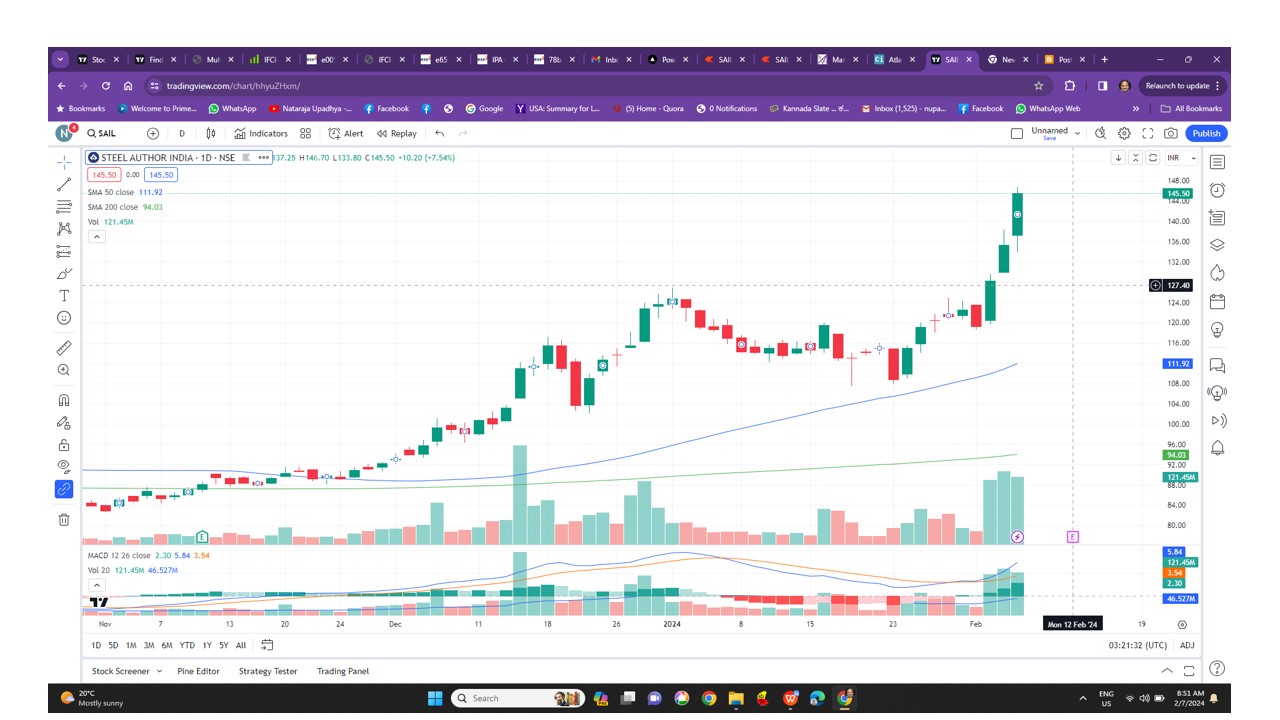
1. Example 1: SAIL daily graph as on Feb 6, 2024.


a) Today’s close = 145.5

b) PrevHigh close = Prev Close = 137.15

c) Positional Prev High = the close of the first green candle which is raising above previous short term high. Previous short term high was approx on 01 Jan 2024, and close that day was 124.75.  The first green or red candle piercing this level was on Feb 02, with candle high of 128.


Therefore, the stop loss works this weay:


For the intra-day trader it is today’s close which is 145.5.

For the swing trader, it is the PrevHigh Close which is 137.5.

For the positional trader, it is the Positional PrevHigh which is 128.


Now, for those who like to place a profit booking order, it is the same for all types of traders.  The level is Today’s Close + Gain thru today which is the difference between today’s close and Prev High close, hence in this example it is 145.5+(145.5-137.15) = 145.5+8.35 = 153.85.


2. Example 2: INGERRAND chart on Feb 6, 2024


a) Today’s close = 3427.5

b) PrevHigh close = Top of third candle behind, which was red  = 3298.75

c) Positional Prev High = same as PrevHigh Close = 3298.75.


Therefore, the stop loss works this way:


For the intra-day trader it is today’s close which is 3427.5.

For the swing trader, it is the PrevHigh Close which is 3298.75.

For the positional trader, it is the Positional PrevHigh which too is 3298.75.


Now, for those who like to place a profit booking order, it is the same for all types of traders.  The profit booking level is Today’s Close + Gain thru today which is the difference between today’s close and Prev High close, hence in this example it is 3427.5+(3427.5-3298.5) = 3427.5+29 = 3456.5.


3. Example 3: Biocon Ltd on Feb 6, 2024


a) Today’s close = 298.65

b) PrevHigh close = Close on 8 Jan 2024 which is higher than prev close = 292.75

c) Positional Prev High = same as PrevHigh Close = 292.75.


Therefore, the stop loss works this way:


For the intra-day trader it is today’s close which is 298.65.

For the swing trader, it is the PrevHigh Close which is 292.75.

For the positional trader, it is the Positional PrevHigh which too is 292.75.


Now, for those who like to place a profit booking order, it is the same for all types of traders.  The profit booking level is Today’s Close + Gain thru today which is the difference between today’s close and Prev High close, hence in this example it is 298.65+(298.65-292.75) = 298.65+5.9= 304.55.


Please note that all NU Quantum Breakthru’s may not repeat for the next day, but it is likely if the short term breakthrough has some juice left still.  The shape of the candle (upper wick is negative, bottom wick is positive), volume and price action together today can indicate this possibility better.


One needs to know how to place both the Stop Loss and Limit Order for profit booking using GTT.


One disadvantage of placing GTT order is that one will not be able to dynamically exploit the possibilities of script behavior in real time. For example, if the scrpit has long wicks next day, one can buy and sell many times and expand the profits.


How to get ready for the market next day?


1. Look at the end of day heat map with both market cap and volume as size. Pick up the stocks above 3% daily return. Similarly pick up all the stocks with highest action for the day from various sources, which is either having higher than usual volume (say double) and having more than 1-2% gain.

2. Eliminate all the stocks which do not have their today’s close higher than previous close. Also, eliminate all the stocks which do not have today’s close higher than most recent high close.

3. For the selected ones, compute stop loss level and profit booking level.

4. Depending on margin, place GTT order for the stocks you like to bet offline.

5. Even if one is in front of the terminal, one can observe the chart of these selected ones and confirm whether the NU Quantum Breakout is continuing for the next day too, and exploit accordingly.

6. The one in front of the terminal next day, will catch the fresh break outs through the Heat Map (I use Trading View Heat Map. I set different timelines, and toggle between market cap and volume to get different breakouts in motion as well as accumulated through the day.)


Anticipate more such beginner friendly profit making trends blogs ahead.


Best wishes,

Nataraja Upadhya

nupadhya@gmail.com

+91 9632824391